

Recently, India’s export performance has generated considerable enthusiasm among the trade and industry. Despite global geopolitical conflicts and severe tariff pressures, India’s exports have shown strong resilience, reaching an all-time high of USD 863 billion in 2025-26, with merchandise exports at USD 441 billion and services exports at USD 422 billion. This strong performance reflects the resilience of our competitive enterprises and strong government support, underpinned by a conducive economic and business environment. Policy reforms, such as the restoration of RoDTEP rates to 100% and DGFT’s nationwide drive to expand the issuance of export obligations discharge certificates to unlock working capital requirements and enhance liquidity for exporters, significantly support exporters at this time of global market uncertainty.
Recently, India’s export performance has generated considerable enthusiasm among the trade and industry. Despite global geopolitical conflicts and severe tariff pressures, India’s exports have shown strong resilience, reaching an all-time high of USD 863 billion in 2025-26, with merchandise exports at USD 441 billion and services exports at USD 422 billion. This strong performance reflects the resilience of our competitive enterprises and strong government support, underpinned by a conducive economic and business environment. Policy reforms, such as the restoration of RoDTEP rates to 100% and DGFT’s nationwide drive to expand the issuance of export obligations discharge certificates to unlock working capital requirements and enhance liquidity for exporters, significantly support exporters at this time of global market uncertainty.
On the price front, inflation remains under control, with the CPI for March 2026 at 3.4%, still within the RBI's target band. Moreover, the government has not passed on the impact of rising global crude oil prices to the public or businesses. Petrol and diesel prices have remained unchanged for the past four years. Many prestigious organisations, including the Government of India, the RBI and ASSOCHAM, continue to forecast overall GDP growth of around 7% for the current financial year 2026-27, supported by a strong demand trajectory, continued infrastructure expenditure and resilient supply chains.
These strong economic fundamentals indicate India’s growing resilience amid extreme uncertainties stemming from the USA-Israel conflict with Iran. Since the war began in February 2026, economic and business activity have remained robust, although financial market volatility has affected investor confidence. Overall, the trajectory has remained steady, and the rupee also seems to be stabilising after a severe depreciation vis-à-vis Trump Tariffs, followed by the geopolitical quagmire.
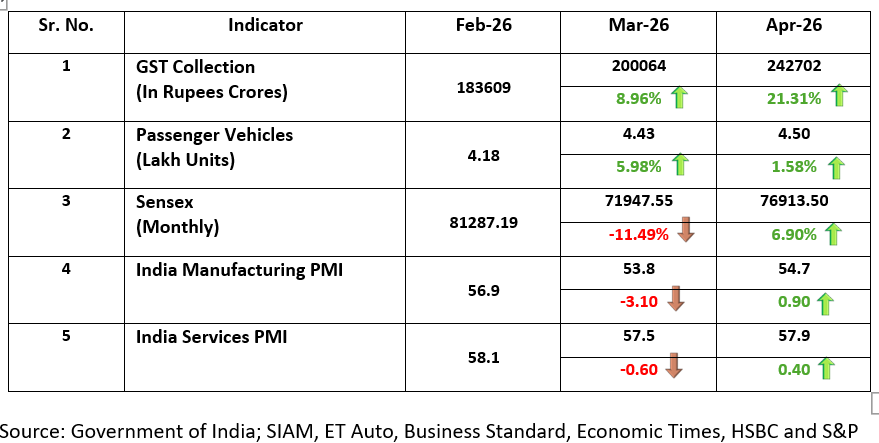
The latest economic indicators, such as GST collections, also indicate robust activity on the supply side, with collections remaining strong in March and April 2026. GST collections grew by about 9% in March 2026 and by 21% in April 2026. GST collections increased from Rs. 183609 crore in February 2026 to Rs. 200064 crores in March 2026 and to Rs. 242702 crores in April 2026. The demand-side indicator, passenger vehicle growth, also showed a robust trajectory in March and April 2026. Passenger vehicle sales grew by about 6% in March 2026, from 4.18 lakh units in February to 4.43 lakh units, and rose again to 4.5 lakh units in April 2026, a 1.5% increase.
Another of the most important indicators, the SENSEX, which reflects the trajectory of investors' sentiment and the economy's economic and policy strength, remained steady amid highly volatile sessions. Although it fell drastically in February 2026, from 81287 to 71947 in March 2026, with a negative growth of about 11%, it recovered in April 2026 with a growth of about 7%, reaching 76913 in April 2026 from 71947 in March 2026.
The prominent global indicator, the Purchasing Managers Index, which reflects overall activity in the manufacturing and services sectors, also recovered in April 2026, although both sectors saw some deceleration in February 2026. India’s manufacturing sector PMI decelerated by 3% in March 2026 to 53.8, down from 56.9 in February 2026, but recovered to 54.7 in April 2026. The services sector PMI also showed strong performance. After decelerating to 57.5 in March 2026 from 58.1 in February 2026, it recovered to 57 in April 2026.
Quick Economic Indicators
On the other hand, the West Asia crisis appears to be easing, as no major escalation has been observed over the past several weeks. Both countries are increasingly exploring pathways towards peace and diplomatic engagement, recognising that prolonged conflict is exerting considerable pressure on their domestic economies and national stability. The continuation of conflict has already disrupted trade flows, heightened geopolitical uncertainty, weakened investor confidence, and increased fiscal burdens on both sides. In addition, sustained tensions have adversely impacted energy markets, industrial activity, tourism, and cross-border commercial prospects across the broader region.
Further escalation could have severe repercussions for the economic growth and development trajectories of both nations, potentially delaying long-term infrastructure expansion, job creation, technological advancement, and foreign investment. The growing realisation that economic resilience and national prosperity cannot be sustained amid prolonged instability is prompting both sides to adopt a more pragmatic and conciliatory approach. Consequently, diplomatic discussions and strategic restraint are gaining prominence, signalling a gradual shift from confrontation towards stability, peace-building, and economic recovery across the wider West Asian region.
Going forward, India has implemented a robust MSME reform, the ECLGS (Emergency Credit Line Guarantee Scheme), which was also in force earlier. During the pandemic, the ECLGS provided meaningful support to MSMEs. The recent approval of ECLGS 5.0 by the Union Cabinet is a timely and highly encouraging step to safeguard India’s growth momentum amid global uncertainties arising from the West Asia crisis. The scheme is expected to strengthen liquidity support for MSMEs, industries, and the aviation sector through an additional credit flow of ?2.55 lakh crore. The provision of a 100% government guarantee for MSMEs and an extended repayment tenure will significantly improve business confidence and ease financial stress. The initiative will help sustain production, protect employment, support supply chains, and support India’s resilient economic trajectory in 2026-27.
In conclusion, the Indian economy has performed well in recent months. Since the West Asia conflict began in late February 2026, the past two months have been challenging for the economy. Economic and business fundamentals have strengthened. Exports, IIP, GST collections, passenger vehicles, and global indicators such as PMI have shown strong resilience, though SENSEX remains highly volatile. This performance has been supported by the proactive and timely policy environment provided by the Government and the efforts of the trade and industry. Policies such as ECLGS 5.0 will bring a significant breakthrough to industry segments. At the same time, signs of de-escalation in West Asia and increasing diplomatic engagement between the conflicting nations offer optimism for greater regional stability and recovery. India’s diversified economic structure, resilient domestic demand, strong infrastructure push, and proactive policy framework position the country favourably to withstand external shocks and sustain a growth trajectory of around 7% in 2026-27, reinforcing confidence among businesses, investors, and global stakeholders.
(Dr. S.P. Sharma is Chief Economist, ASSOCHAM and Managing Director, Chief Economist, NDIM NEO Research Centre-NNRC • Former Chief Economist, PHDCCI (PHD Chamber of Commerce and industry, India)
Disclaimer: The opinions expressed in this article are the personal opinions of the author. The facts and opinions appearing in the article do not reflect the views of Indiastat and Indiastat does not assume any responsibility or liability for the same.
"India’s Food Resilience Demands FPOs to Evolve: Climate Risk Must Be a Core Strategy"... Read more








.png)